
Decatur City Directory Runs
No single Decatur historical collection is complete. The Alabama Department of Archives and History finding aid identifies sparse printed volumes and a longer microfilm run. The Library of Congress supplies digitized telephone books, while FamilySearch catalogs one later Southern Bell book and early Morgan County records. Publisher names are not given for every ADAH item. A volume should not be called a Polk directory unless its own title page says so.
| Collection | Years | Where Held | Access |
|---|---|---|---|
| Printed Decatur directories | 1913-14, 1917-18, 1958, 1969 | ADAH Box 52 | Archives reading room |
| Directory microfilm | 1942-55 | ADAH Reference Room | In-person microfilm |
| Decatur telephone books | 1936-77 in documented runs | Library of Congress | Free digitized images |
| Decatur-Athens regional volumes | 1996, 1998, 2001 | ADAH Boxes 233, 206, 231 | Archives reading room |
| Southern Bell Decatur directory | 1957 | FamilySearch Books | Login or image limits may apply |
Those holdings leave real gaps. They do not prove that no other edition was printed or survives elsewhere. Telephone-book runs include July 1936 through January 1953, November 1953 through December 1964, and later groups through February 1977. Each reel may contain several dates, so record the cover or page date from the image itself. The shelf description alone cannot prove that a named resident appeared in every year.
ADAH Decatur Directory Shelves
ADAH separates the physical sources by format and container. The early and later bound items sit in labeled boxes, while the 1942-55 Decatur directory sequence is microfilm in the Reference Room. Researchers should arrive with a short year list and the LPR104 finding-aid reference. That makes it easier for staff to distinguish a city volume from the regional Decatur-Athens titles.
The ADAH access guidance explains how to plan a records visit and ask about materials. Its screenshot shows the state archive as an access point, not a universal online name index.
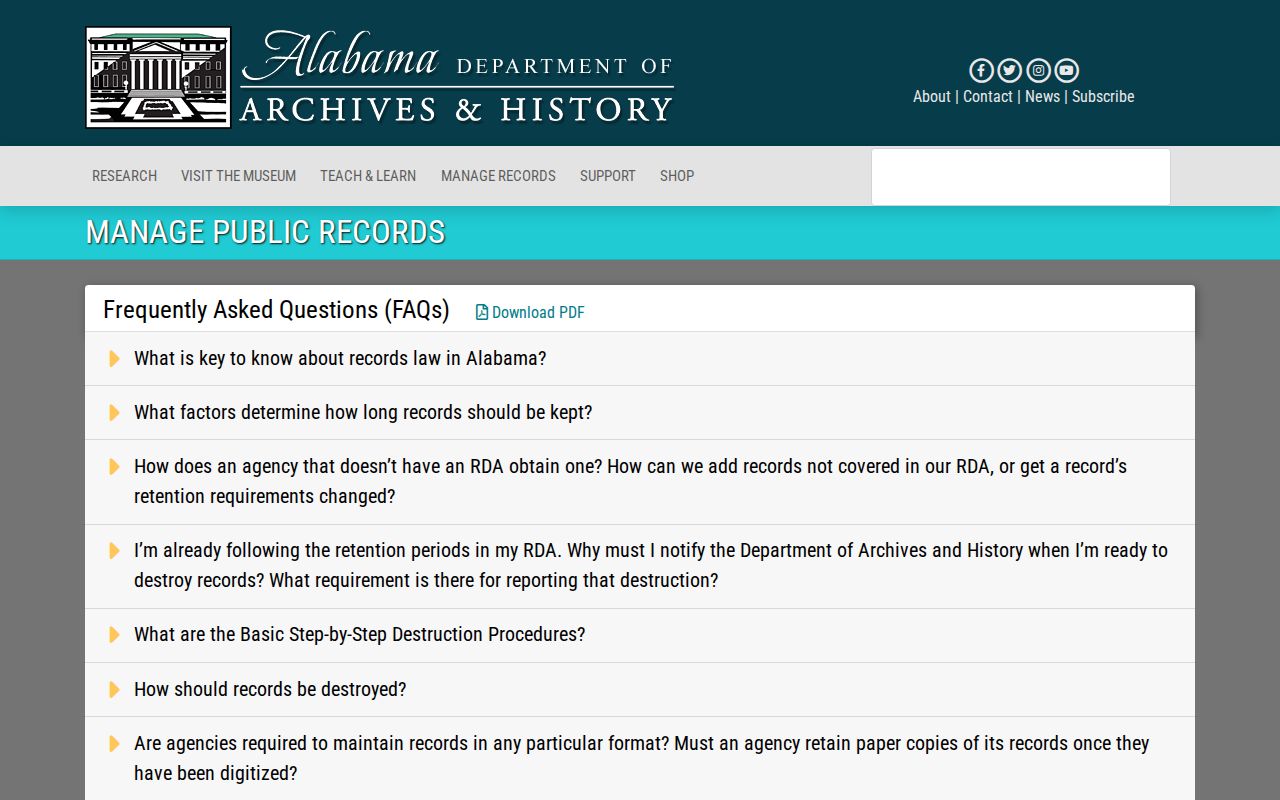
The captured page is useful for planning access, while the separate finding aid supplies the exact Decatur years and boxes.
Note: Confirm reading-room rules and hours before travel, since repository procedures can change even when the catalog citation stays the same.
Decatur Telephone Directory Reels
The Library of Congress Decatur telephone reel offers free page images, browse controls, and downloads. It fills many years between the sparse printed archive holdings. Searchers should inspect adjacent alphabetic pages because optical character recognition, or OCR, can miss initials, faded type, and abbreviated street names.
A sampled classified page shows what this source can prove: a printed business or personal name, category, abbreviated address, telephone number, advertisements, and at times a map-grid reference. It does not prove that all editions list spouses, trades, or owner and renter marks. In fact, the inspected classified pages did not show those fields. An entry such as a grocery with a street number demonstrates the phone book's format, not the conventions of an unseen residential volume.
Note: A listed subscriber may be one member of a household, and an unlisted phone can leave a resident absent from the book.
Reading Decatur Directory Entries
Read only the fields printed on the page. A Decatur telephone listing may give far less detail than a residential city volume. Photograph or note the title page, publication date, page number, and abbreviation key before transcribing a person. That context keeps a later researcher from treating an initial, street shorthand, or classified listing as a full household profile.
| Printed name | Copy spelling, initials, and punctuation exactly before trying variants. |
|---|---|
| Category or trade | Present on sampled classified pages; do not assume every personal entry carries it. |
| Street line | Record number, directional, and abbreviated street as printed. |
| Telephone number | Shows the listed service for that edition, not a present number. |
| Grid or advertisement | May help place a business, but does not identify a household. |
- Criss-cross directory
- A section arranged by street and house number rather than by surname. Its presence must be checked in the actual volume.
- Householder index
- An address-ordered tool naming the listed person tied to a dwelling. Not every local edition has one.
- Abbreviation key
- The volume's own list of shortened words and marks. It is the safest source for decoding that edition.
If a spouse, trade, or owner mark appears, copy the exact wording and symbol. If it does not, leave that field blank. The ADAH catalog does not establish a publisher or a common format for every Decatur volume.
Decatur Directory Name Changes
A missing name may reflect geography rather than a move. New Decatur incorporated in 1887, became Albany in 1916, and merged into Decatur in 1927. Fairview also figures in the pre-consolidation landscape. A person could remain at one place while the locality printed above the entry changed.
Search pre-1916 sources under New Decatur. Try Albany for 1916-27, then Decatur after consolidation, while allowing for publishers to lag behind a civic change. The directory trail is most reliable when the old street label is compared with a legal description, census enumeration, or period map. This local naming quirk is especially important around Albany and the old Decatur street grids.
The local publication chronology can be summarized without claiming a continuous run:
- 1913-18: early printed Decatur holdings survive in selected years.
- 1936-77: telephone reels create a long, though not complete, listed-subscriber layer.
- 1942-55: ADAH preserves a directory microfilm run.
- 1958-2001: selected city and regional volumes appear in later archive boxes.
Morgan Archives Directory Research
Morgan County Archives is Decatur's strongest offline fallback. Its holdings include old directories, school annuals, church and community histories, surname files, cemetery indexes, census and voter material, photographs, probate records, and local newspapers. Bound Decatur Daily volumes begin in 1919, with earlier issues available on microfilm.
The Archives is at 624 Bank Street NE and is open Tuesday through Friday, 8 a.m. to 4:30 p.m. Published basic staff research costs $15 for an Alabama requester or $25 for an out-of-state requester, including ten copies, then $1 per added copy. Personal cameras are allowed. Call 256-351-4726 first when the request involves land, tax, recent, or sensitive material.
Archive tip. Send one surname, a tight year range, known address, and any volume clue. A narrow request makes the fixed-price research service more useful.
Map Decatur Directory Addresses
Directories name people, while maps test address continuity. The 1894 Decatur and New Decatur Sanborn atlas shows building footprints, materials, uses, and period street labels. Confirmed local editions also include 1888, 1898, 1903, 1908, and 1913, with a 1927 atlas cataloged. A Sanborn sheet does not name the occupant. Pair it with the directory, census, or deed.
The map is strongest when a street number changes or a locality label shifts. Match the block, footprint, and street name. Then compare the parcel's legal description and the city entry. The legal description can remain stable through postal or street changes. Modern address-led research belongs in the Decatur street directory, while the historical shelf remains the source for who was listed at the time.
Note: No authoritative citywide Decatur street-renumbering table was found, so a researcher should not assign an old number by guesswork.
Trace Family in Decatur Directories
Family research works best as a dated chain, not a single hit. Start with a known event and choose the nearest Decatur volume or telephone year. Record what the entry truly shows. Then move one available edition at a time and explain each gap with another source. The 1950 federal census is the newest public census and can supply a household snapshot that a listed phone subscriber cannot.
- Search surname variants, initials, and the correct era name: New Decatur, Albany, or Decatur.
- Copy the cover date, printed address, phone, and any relationship or trade clue actually shown.
- Check the prior and next available years for a move, first appearance, or disappearance.
- Pair the sequence with the 1940 or 1950 census, then use Sanborn sheets or deeds to bridge an address change.
- Follow a final disappearance through the Archives newspaper run, Probate estate material, cemetery indexes, or an official obituary archive.
Absence is not proof of death or departure. The person may have used another spelling, shared a listed phone, lived outside the publisher's cutoff, or chosen no listing. A modern record can be checked through the Decatur resident lookup workflow, but names should only be joined when dates, relatives, addresses, or record numbers agree.
Decatur Records That Survived
Decatur's paper trail survived several shocks. Civil War destruction reportedly left only three city buildings, including the 1834 Old State Bank. Morgan County courthouse fires in 1926 and 1938 caused losses. Yet surviving deeds begin in 1820, marriages in 1821, and probate material reaches the county's earliest era. Claims that every record burned are false.
FamilySearch catalogs deed and mortgage indexes, probate groups, and marriage collections that can bridge damaged or transferred county files. Morgan Archives holds inactive originals and local copies. ADAH adds state microfilm and the Decatur archive boxes. These channels should be treated as separate evidence, not duplicate proof. A catalog record can establish that a record group survives, but a certified copy must still come from the custodian that holds the official instrument.
That layered survival is why Decatur research often succeeds after a directory gap. A phone book may place a listed name near the event. The census can identify a household. A deed or probate file can then supply the dated legal link.