
Finding Decatur Residents Step by Step
Begin with the fact already known. A street address belongs in the property and GIS systems. A full name belongs in property, court, business, and historical indexes. An event such as a marriage or death belongs with the record custodian for that event. Dates matter because a roll proves only what its keeper recorded at a particular time. The strongest Decatur directory result joins two or more independent sources without merging people who merely share a name.
Ownership is not occupancy. Voter registration is not a complete household list. A deed identifies parties to a land transfer, while a city directory or telephone book reflects the publisher's cutoff and inclusion rules. Renters, children, unlisted subscribers, and people who recently moved may be absent. Keep each label precise and save the record date.
- Use the city boundary layers to choose Morgan County or Limestone County for the address.
- Search that county's property roll by owner, address, or parcel number.
- Check a known voter through Alabama VoterView and use court indexes only when relevant.
- Carry the owner name and legal description into the county deed or probate system.
- For an older trail, move to city directories, telephone books, census schedules, and archives.
Decatur Records Cross Two Counties
Most Decatur records are kept in Morgan County, where Decatur is the county seat. Yet incorporated land reaches north and northeast into Limestone County. That split controls deeds, assessment, probate, circuit and district courts, elections, and county jail records. A Decatur mailing label does not resolve it. The Decatur GIS guide identifies County Boundary and ZIP Boundary layers, and the county parcel maps supply a second check.
Citywide records follow a different line. The City Clerk, Decatur Municipal Court, police, permit, zoning, and code offices serve the municipal territory even when a parcel lies on the Limestone side. A city ordinance case therefore stays with Municipal Court, while a Limestone deed is recorded in Athens. Solve this geography before starting a name search. It prevents a false no-result from the wrong office.
Key point: Postal city, ZIP code, city limits, and county lines describe different boundaries. Confirm the parcel before choosing a custodian.
Decatur Residents Directory Offices
Three office types form the current resident-record trail. Revenue offices tie assessed owners to parcels. Probate offices record land instruments and estates. Elections offices maintain voter registration under Alabama law. Morgan and Limestone operate separate systems, so north-side addresses may require Athens contacts even though the postal line says Decatur.
Limestone County Offices
100 South Clinton Street
Athens, AL 35611
Revenue: 256-233-6433
Counter and telephone channels remain important. Morgan Probate's online cutoff and image charges were not published in the researched sources. The office temporarily moved public functions during the 2026 courthouse renovation, while recording and online service continued. Call before visiting to learn whether the public room is at the courthouse or the temporary location.
Decatur Property Records by Name
The Morgan Capture CAMA search supports owner or name, address, and parcel routes. The Revenue landing page separates Real Property from business personal property and GIS maps. Data is uploaded often, but the county warns that it may lag. Save the tax year and retrieval date when a recent deed has not yet reached the roll.
| Search route | Best starting fact | Useful result | Limit |
|---|---|---|---|
| Owner or name | Spelling and initials | Matching assessed parcels | Same-name owners need another identifier |
| Address | Street number and name | Physical parcel and assessed owner | Mailing and situs addresses can differ |
| Parcel | Parcel number from a card or map | Direct property match | Formats differ by county |
Limestone Citizen Access confirms the same three broad modes: Name, Parcel Number, and Address. Its results can show appraised and assessed value, taxable buildings, taxes, and a map. Those fields support an assessed-owner statement. They do not establish who sleeps at the property or identify family relationships.
The manifest image below comes from the Alabama Just One Look court portal, a separate paid source that should be used only after property and jurisdiction clues narrow the person.
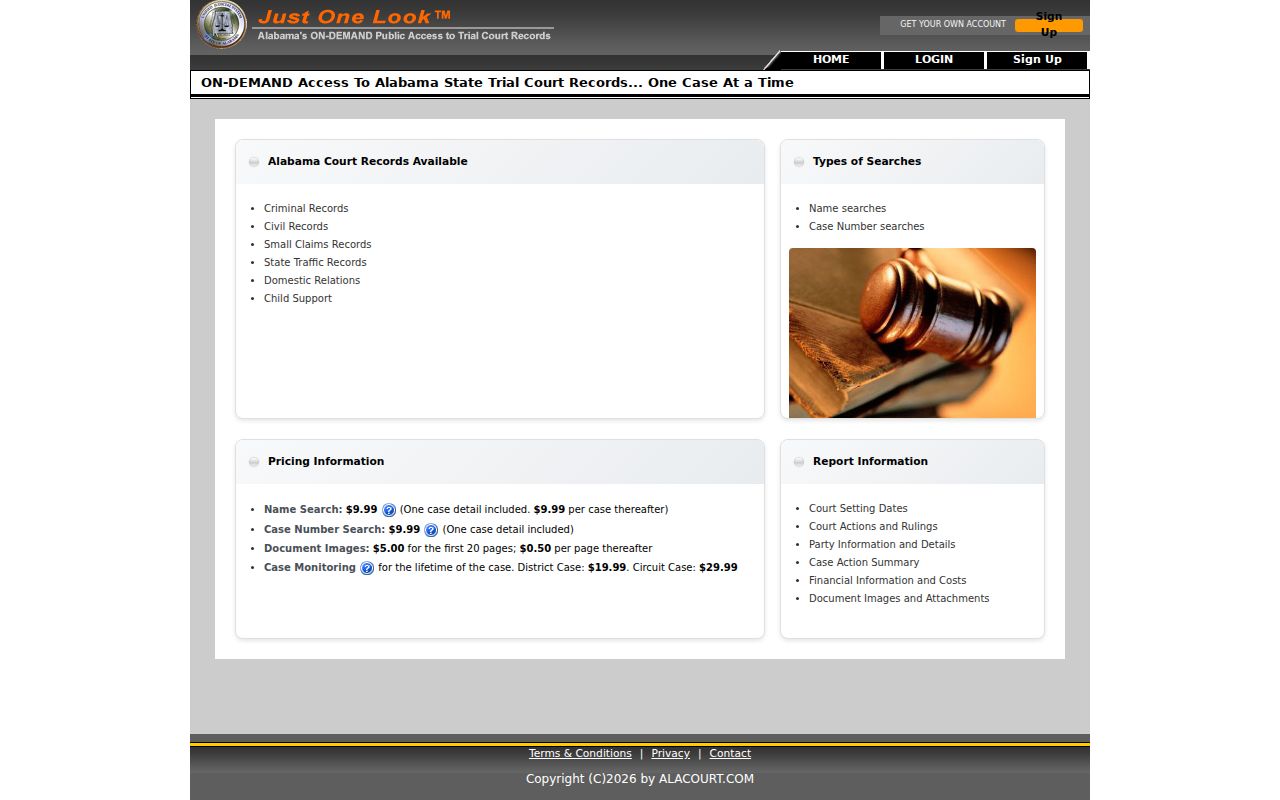
The screen illustrates why one portal cannot act as the whole directory: a court party result confirms case activity, not a current home address.
Current Decatur Resident Directory Sources
No official source lists every Decatur household. Each roll includes a defined class of people or parties. A useful directory search selects the roll by the question asked, then confirms the result elsewhere.
| Local source | People or parties shown | Record keeper | Access path |
|---|---|---|---|
| Property roll | Assessed owners | Morgan or Limestone Revenue | Free web search, map, counter |
| Recorded land index | Grantors and grantees | County Judge of Probate | Vendor portal, phone, public room |
| Voter confirmation | One known registered voter | Alabama Elections | Free VoterView tool |
| Court index | Named case parties | State and local clerks | Paid portal, free terminal, request |
| Business entity file | Entity officers and agents | Secretary of State | Free online modes |
The official rolls carry dates, custodians, and correction routes. Commercial people-finder products combine data from many sources but may not show when a fact changed or which office supplied it. For genealogy, reconnecting, estate work, seller verification, or civic research, the dated official record is easier to test and correct.
Decatur Voter Records Have Limits
Alabama VoterView confirms one known voter's status, polling place, and districts. It is not a public street browser. Alabama does not register voters by party, and participation history never reveals ballot choices. A no-match can reflect a spelling problem, recent update, inactive status, or the wrong county rather than absence from Decatur.
A separate Elections Division request form permits county, city, or district geography and selected identity, address, status, and participation fields. Current Ala. Code § 17-4-38, effective June 1, 2026, caps the electronic list fee at $1,000 and restricts sale, publication, and commercial use outside statutory exceptions. Social Security and driver-license numbers, email, non-release phones, and protected-voter data are withheld. A public directory can explain those fields but cannot republish a street roster.
The image was captured from the Alabama Code page for the Open Records Law.
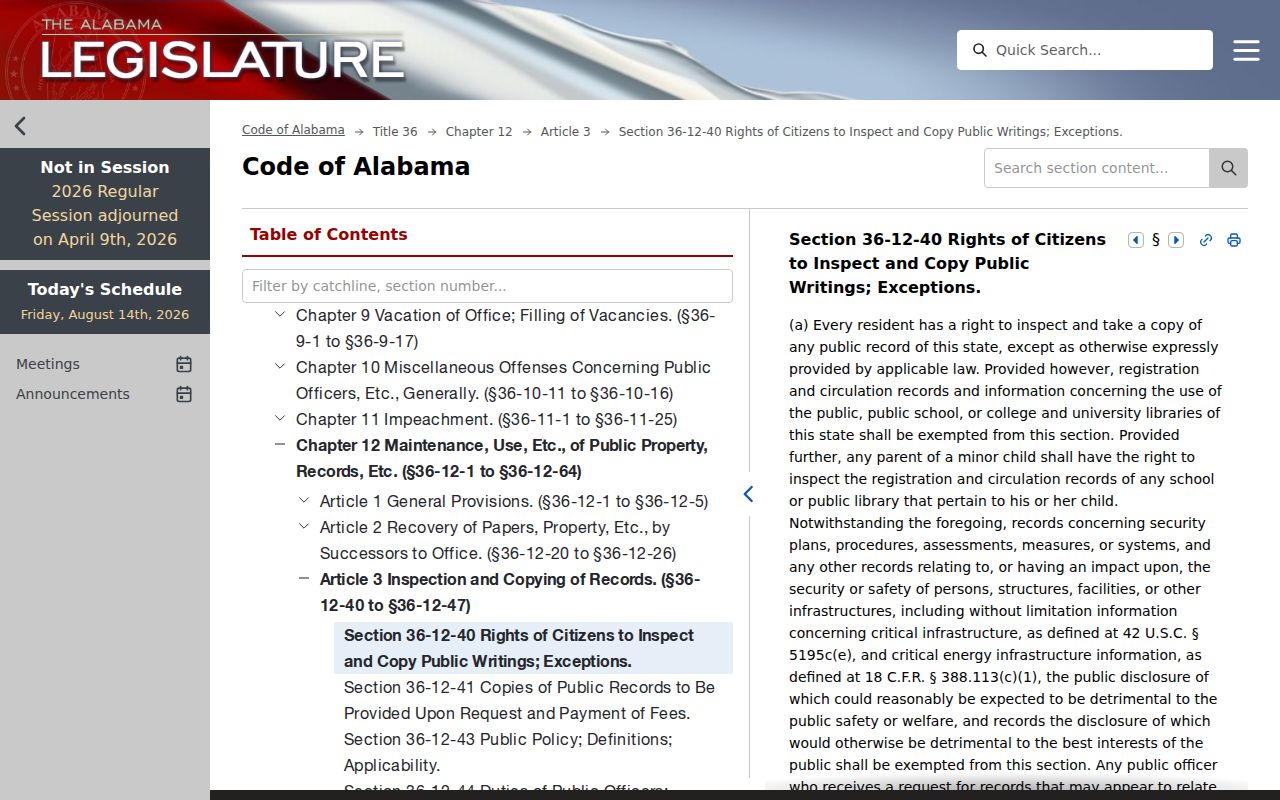
It anchors the broader access rule, while voter files remain subject to their own narrower election statutes.
Three Decatur Court Record Paths
Decatur court research splits among municipal, state or county, and federal systems. Decatur Municipal Court handles city misdemeanors, traffic, parking, and City Code matters. Morgan is Alabama's Eighth Judicial Circuit, while Limestone is the Thirty-Ninth. Federal filings belong in the Northern District of Alabama through PACER. A miss in one system says nothing about the others.
Just One Look searches Alabama trial courts by name or case number across several case types. A search costs $9.99 and includes one case detail; added case details cost $9.99 each. Morgan also provides free Alacourt research terminals in Circuit Clerk and Law Library areas. A narrow written request can be mailed or faxed, and the clerk charges $10 for a computerized search or $25 for a paper or non-active search. Juvenile, youthful-offender, sealed, and victim information stays closed.
Municipal record checks use the city's own signed form. Subject authorization is required for a criminal record check. Requesters may choose plain or certified copies, all associated records, or disposition only. A disposition is the recorded outcome of the case, not merely the charge.
Decatur Vital Records by Event
The Alabama Center for Health Statistics keeps statewide birth and death certificates from 1908, marriage certificates from August 1936, and divorce certificates from 1950. Birth records remain restricted for 125 years and death records for 25 years. Marriage and divorce certificates are unrestricted when enough facts are supplied. Earlier marriages belong with county Probate; earlier divorces belong with the granting Circuit Clerk.
A signed combined vital-record application can go by state mail, an Alabama county health department counter, or the authorized online and telephone channel linked by the department. The base search and first certificate cost $15, and extra copies of the same record ordered together cost $6. Mail normally takes seven to ten days. Restricted orders require proof of eligibility and identification.
An Alabama-born adoptee age 19 or older has a distinct personal route under Ala. Code § 22-9A-12. The adoptee may request their own noncertified original certificate and sealed legal papers for $25 with an original signature. It is a self-only process, not a general public name index.
Morgan Archives Backs Decatur Searches
Morgan Archives is the strongest offline fallback when a portal stops, an old case moves to microfiche, or a resident trail predates current systems. At 624 Bank Street NE, it opens Tuesday through Friday from 8 a.m. to 4:30 p.m. Basic staff research costs $15 for Alabama residents and $25 for out-of-state requests, including ten copies, then $1 per added copy. Personal cameras are allowed.
The holdings include old directories, school annuals, maps, family and surname files, cemetery indexes, probate estate material, marriage, court, voter, and census records. Bound Decatur Daily issues start in 1919. Original marriage books run from July 18, 1821 through August 6, 1936, with an early gap before July 1821. Call ahead for recent, sensitive, land, or tax material and give staff a narrow name, date, book, or record group.
Requesting Decatur Public Records
Alabama Open Records Law, Ala. Code §§ 36-12-40 through 36-12-46, gives Alabama citizens or residents inspection and copy rights unless another statute closes the material. Act 2024-278 added the current procedure. An agency may require its published form and channel. Standard requests should receive acknowledgment within ten business days and a substantive response within fifteen business days after acknowledgment. Those are benchmarks, not a universal delivery promise.
Describe a record, date range, office, subject, address, case number, or permit number rather than asking an office to research a person broadly. Time-intensive work may require an estimate and prepayment. Judicial records follow court procedures rather than Article 3. More than 250 exemptions exist, including protected library registration and circulation data. If a Decatur record is not online, use the exact custodian's form, counter, mail, email, or telephone process.
- Roll
- A list maintained for a defined public purpose, such as assessment or voting.
- Index
- A finding aid that points to a record; it may not include the document image.
- Parcel
- A mapped unit of land with its own identifier and legal description.
- Criss-cross directory
- A directory arranged by street or telephone number rather than only by surname.
Historical Decatur Resident Directories
Printed Decatur city-directory holdings are specific rather than continuous. The Alabama Department of Archives and History lists 1913-14, 1917-18, two 1958 volumes, and 1969 in collection LPR104, plus 1942-55 microfilm. Later regional volumes cover 1996, 1998, and 2001. The catalog does not identify every publisher, so none should be labeled as a Polk directory without checking its title page.
The Library of Congress supplies digitized telephone-directory runs from July 1936 into 1977, with some gaps. A sampled classified page shows printed business or personal name, category, abbreviated address, phone, advertising, and sometimes a map grid. OCR can misread it. Browse the scan and record the cover date. The full shelf, entry conventions, and household-tracing method belong on the Decatur city directory page.
Decatur Records Survived Two Fires
Morgan County courthouse fires in 1926 and 1938 caused losses, but they did not erase the county trail. Cataloged deeds reach 1820, deed and mortgage indexes reach 1820, and probate and marriage material begins in the early county era. FamilySearch catalog descriptions can bridge remote research, while certified copies still come from Probate or the responsible clerk.
Place names also shift. New Decatur incorporated in 1887, became Albany in 1916, and merged into Decatur in 1927. Old State Bank, built in 1834, survived the Civil War destruction that left only three city buildings. A historical resident search must use the name printed in the record's own period. Modern Decatur alone will miss Albany and New Decatur entries.
Lawful Decatur Directory Research
Public does not mean complete or fit for every use. Protected-voter addresses may be omitted under Ala. Code § 17-4-33 and election rules. Protection-order filings may omit addresses under § 30-5-5. Sealed court files, juvenile matters, victim data, restricted vital records, library circulation data, utility customer details, and private group rosters remain outside ordinary public access.
Use Decatur directory records for lawful personal research such as genealogy, reconnecting with relatives or classmates, estate and heir work, seller verification, property history, and civic transparency. Do not expose private identifiers, infer guilt from a booking or charge, or use an address trail to stalk, harass, threaten, or harm anyone. Corrections must go to the office that owns the record.
Lawful use: Keep searches tied to a legitimate personal purpose, respect withheld addresses, and stop when a record is sealed or restricted.